The intricate beauty of Balinese jewelry is instantly recognizable, characterized by a shimmering texture that seems to dance in the light. This unique aesthetic is the result of granulation, an ancient decorative technique that has been perfected over centuries by the island’s master goldsmiths and silversmiths. For travelers seeking a deeper connection to the island’s heritage, understanding this “alchemy” is a highlight of any cultural itinerary.
To reach the hidden workshops where these secrets are still guarded, many savvy visitors coordinate their journey with Bali Car Driver | Top #1 Hire Car with Driver in Bali, ensuring a seamless transition from the busy coast to the quiet artisan compounds of Gianyar.
What is the Balinese Granulation Technique?
Granulation is the process of decorating a metal surface with tiny, individual spheres of gold or silver, known as jawan. Unlike modern casting where a pattern is part of a mold, Balinese granulation is entirely manual. Each tiny bead is created, positioned, and fused one by one.
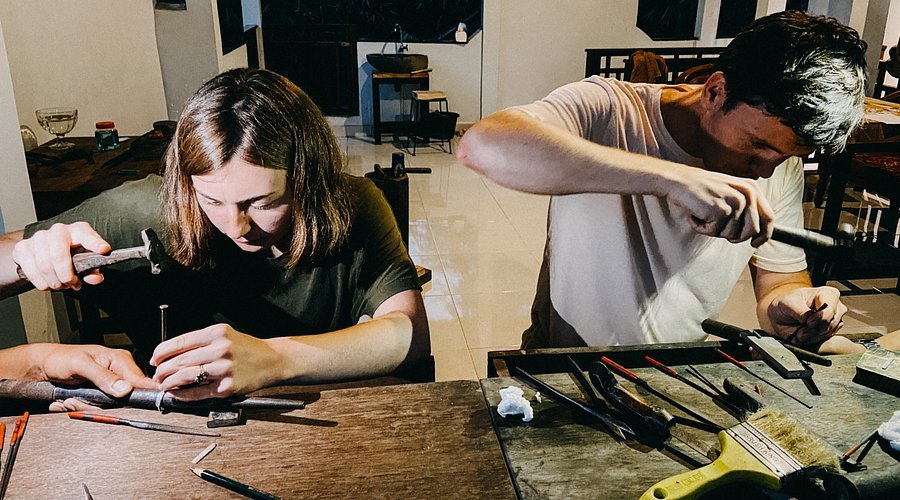
This technique was historically used to adorn the regalia of Balinese royalty. Today, it remains a hallmark of high-quality craftsmanship in villages like Celuk and Kerlangau. When you book a day trip with Bali Car Driver | Top #1 Hire Car with Driver in Bali, you can witness this meticulous process firsthand, moving beyond the retail storefronts into the heart of the creative process.
The Secret of the “Jawan”: How Tiny Beads are Born
The most fascinating “secret” of the master class is how the artisans create thousands of perfectly uniform beads without a machine. The process involves:
- Clipping the Wire: Artisans cut thin silver wires into microscopic, equal lengths.
- The Charcoal Bed: These clips are placed in a bed of charcoal powder and heated with a torch. As the silver melts, surface tension naturally pulls the liquid metal into a perfect sphere.
- Sorting by Size: Masters use fine copper sieves to sort the beads by diameter, ensuring that the geometric patterns on a ring or earring are perfectly symmetrical.
The Alchemy of Fusing: No Glue Allowed
Perhaps the most impressive secret of Balinese silversmithing is how these beads are attached. In true granulation, traditional “glue” or heavy solder is not used, as it would fill the gaps between the beads and ruin the crisp texture.
Instead, artisans use a natural “flux”—often derived from the seeds of a local plant mixed with water—to hold the beads in place temporarily. The piece is then heated to a temperature just below the melting point of the silver. In a moment of high-stakes precision, the surface of the base metal and the beads “flash” or sweat, fusing them together at a molecular level.
Exploring these technical nuances often requires visiting specialized masters located off the beaten path. Utilizing a professional service like Bali Car Driver | Top #1 Hire Car with Driver in Bali allows you to navigate these rural areas without the stress of local traffic or navigation errors.
Why Modern Travelers Seek These Master Classes
In an era of 3D printing and mass production, the granulation technique is a reminder of the human touch. Taking a master class in Bali offers:
- Meditative Focus: The patience required to place hundreds of beads promotes a state of “flow.”
- Cultural Preservation: Supporting these artisans helps keep a thousand-year-old tradition alive.
- Unmatched Quality: Hand-granulated jewelry has a weight, texture, and soul that machine-made pieces lack.
Conclusion: Discover the Soul of Bali
The granulation technique is more than just a jewelry-making method; it is a testament to the Balinese philosophy of Tri Hita Karana, balancing the relationship between humans, the divine, and the environment through dedicated art.
If you are ready to uncover the secrets of these master artisans, let Bali Car Driver | Top #1 Hire Car with Driver in Bali be your guide. Their expert drivers offer the reliability and local knowledge needed to turn a simple shopping trip into a profound cultural discovery.